
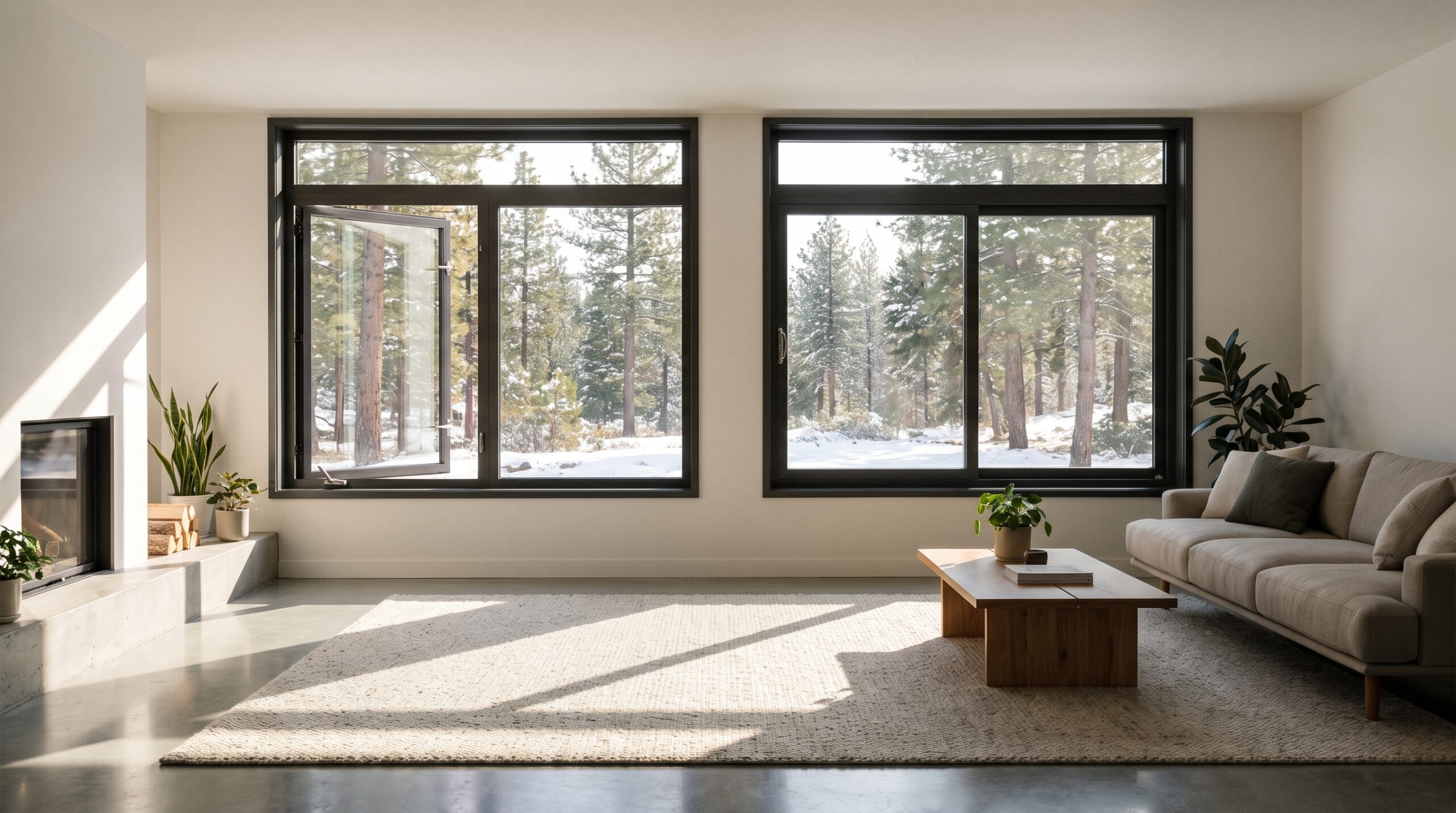
Selecting the right house windows is one of the most critical building envelope decisions for homeowners in harsh northern climates. For property owners planning window replacements, especially in regions subject to dramatic temperature swings and strong seasonal winds, the choice between a casement (crank-out) window and a sliding window directly impacts thermal comfort and heating efficiency. This side-by-side evaluation compares compression seal airtightness, ventilation airflow, hardware durability, and winter maintenance requirements to help you make an informed fenestration choice.
What Are Casement and Sliding Windows?
Casement windows are hinged on one side and swing outward like a door, typically operated by a manual crank mechanism. They utilize continuous perimeter compression gaskets, such as durable EPDM or synthetic elastomer seals, that press firmly against the window frame when the sash is closed and latched.
Sliding windows, available in horizontal or vertical configurations, feature sashes that glide parallel to the frame along dedicated tracks. To permit smooth manual movement without binding, sliding windows rely on woven brush-pile weatherstripping or flexible wiping fins rather than true compression seals.
Side-by-Side Comparison Matrix
|
Feature / Metric |
Casement Windows (Crank-Out) |
Sliding Windows (Horizontal & Vertical) |
|---|---|---|
|
Primary Sealing Mechanism |
Continuous perimeter compression gaskets |
Woven brush-pile or flexible wiping vinyl fins |
|
Airtightness Performance |
High airtightness (commonly CSA Class A3) |
Moderate airtightness (typically CSA Class A1 to A2) |
|
Ventilation Capacity |
Nearly 100% of operable sash area |
Maximum 50% of window opening area |
|
Winter Freeze-Up Risk |
Low; sloped sill profile sheds meltwater |
Elevated; sill track can collect snow and meltwater |
|
Bedroom Egress Compliance |
High; achieves required clear opening in smaller wall cutouts |
More restrictive; requires wider openings to meet clear width standards |
Airtightness and Seal Mechanics
Casement windows provide superior airtightness because their closure mechanism functions much like a refrigerator door. When the multi-point locking lever engages, it draws the operable sash evenly against continuous perimeter elastomer gaskets. Because the sash seals directly by compression rather than sliding across the weatherstripping, the gaskets avoid abrasive wear while maintaining consistent perimeter pressure. Under the North American Fenestration Standard (CSA A440 / NAFS), quality multi-point locking casements routinely achieve the rigorous Class A3 airtightness rating.
Sliding windows are inherently more susceptible to air infiltration. To allow the sashes to glide freely without binding, manufacturers must design intentional clearance tolerances into the frame tracks and rely on brush-pile or flexible vinyl fins rather than continuous compression gaskets. Under standard fenestration testing, sliding units typically achieve lower airtightness ratings (often Class A1 or A2) and permit noticeably higher air leakage than compression-sealed casement units of comparable dimensions.
The Aerodynamic Paradox of Wind Pressure
Exterior wind pressure affects these two window designs in contrasting ways. On outward-opening casement windows, positive wind pressure against the exterior face pushes the sash directly inward against the frame stop and compression gaskets. In gusty conditions, this inward force naturally reinforces the seal, helping limit unwanted air infiltration during storms.
Conversely, because sliding sashes require operational track clearance, direct wind pressure pushes the sash inward toward the interior track edge. On wider units, strong wind gusts can cause slight deflection at the meeting rail, which compresses interior weatherstripping while unloading exterior brush seals and allowing cold air to enter along the track perimeter.
Ventilation Control and Airflow
In standard two-lite configurations, a sliding window can only open to roughly 50% of its total frame opening because one sash must slide over the other, keeping half the space covered. A casement window swings outward on hinges, clearing the sash opening to provide ventilation across nearly the entire operable aperture.
Casement windows also function as an effective wind scoop. Wind rarely strikes a home’s exterior wall at a purely perpendicular angle, often sweeping parallel to the facade instead. While a sliding window relies primarily on direct exterior drafts to move air, an open casement sash can be angled outward to catch passing lateral breezes and funnel fresh outdoor air directly into the room.
Maintenance, Cleaning, and Winter Freeze-Ups
Cleaning convenience frequently favors casement windows on upper floors. Many quality casement hinges feature washability tracks: when cranked open toward 90 degrees, the hinge mechanism shifts the sash edge inward away from the frame jamb. This clearance creates an accessible gap that allows homeowners to clean both the interior and exterior glass surfaces safely from inside the home without using an exterior ladder.
Winter freeze-up is an operational challenge for horizontal sliding windows in cold climates. The bottom track extrusions act as shallow channels that can accumulate dust, blowing snow, and condensation runoff. If standing moisture collects in the track during a thaw and freezes during a sudden temperature drop, the ice can prevent the sash from sliding and potentially tear brush weatherstripping if forced. Casement windows do not use recessed bottom tracks; their sloped exterior sills shed moisture away from the frame, significantly reducing the likelihood of winter freeze-ups.
Designing for Harsh Northern Climates
Northern continental climates impose substantial mechanical stress on residential window assemblies. In regions like southern Alberta, winter Chinook weather patterns can drive temperature swings of 20 to 30 degrees Celsius within a single day. Because vinyl and composite frames naturally expand and contract with large thermal shifts, track-based sliding windows can experience changes in clearance tolerances that reduce brush seal effectiveness. Compression-sealed casements, by contrast, use resilient elastomer gaskets that maintain contact despite moderate thermal movement.
To manage these thermal demands, owner-operated Window and Door Guys provides residential window replacements tailored to severe regional weather. By pairing multi-chamber uPVC casement assemblies with resilient EPDM gaskets, they help ensure window installations absorb seasonal temperature swings without losing seal integrity. Their turnkey installation services focus on code compliance and energy efficiency, supported by on-site consultations and clear estimates.
Frequently Asked Questions
What is the best approach for a vinyl window replacement in Calgary?
A vinyl window replacement in Calgary benefits from durable frame construction and high-performance glazing, such as multi-chamber uPVC extrusions and triple-pane glass, to handle rapid freeze-thaw cycles and strong prairie winds. Homeowners should prioritize assemblies meeting NRCan ENERGY STAR Version 5.0 Most Efficient criteria. Typical professionally installed vinyl replacements in the local market range between $650 and $1,400 or more per opening, depending on dimensions, glass packages, and structural retrofit requirements. Local contractors such as Window and Door Guys assist homeowners with selecting and installing climate-appropriate configurations backed by professional oversight and flexible financing options.
Why is a casement window replacement in Calgary highly recommended?
A casement window replacement in Calgary is widely recommended for wind-exposed west- and north-facing elevations because multi-point locks compress continuous perimeter gaskets firmly against the frame, maintaining an airtight barrier even in high winds. These units consistently achieve top-tier CSA A3 airtightness ratings and effectively satisfy Alberta Building Code bedroom egress standards (NBC(AE) Sentence 9.9.10.1) requiring an unobstructed opening of at least 0.35 square meters within relatively compact wall cutouts. For homeowners planning upgrades, Window and Door Guys delivers customized casement installations configured for regional climate demands.
Choosing the Right Window Style
When evaluating upgrades for your home, prioritizing proper weather sealing and hardware longevity ensures your investment pays off in energy savings and comfort. By understanding the mechanical differences between casement and sliding mechanisms, you can select the optimal house windows for your property’s specific wind exposure and architectural layout. Whether you are budgeting for a single egress upgrade or exploring whole-home window and installation solutions, partnering with local fenestration specialists helps ensure your project meets relevant building code requirements and delivers long-term comfort.